
A virus does not choose its hosts. It spreads to whoever is close, copies itself, and moves on. The host is a vehicle, not a destination. And the thing that arrives at the end of the chain is rarely the thing that started it. Enough copies in, it has mutated into something the first carrier would not recognize.
A brand that chases virality works the same way.
We keep telling founders to go viral, as if reach and resonance were the same word. They are not. Reach is how many people the thing touched. Resonance is how many of them it changed. You can have an enormous amount of the first and almost none of the second. Most viral moments are exactly that.
The math of reaching everyone
Every brand begins as something for a specific person, solving a specific problem. The moment you try to reach everyone, you have to speak to people that person is not. So you soften. You reach for whatever is trending, because a trend is the closest thing we have to a shared language between strangers. And with every softening the message gets more generic, until it says nothing to anyone in particular.
Here is what that trade costs you. People do not trust brands. They trust people. Recommendations from someone you know are the most trusted form of marketing there is, at 83 to 88% across Nielsen's survey years, while trust in paid social ads sits below half of that. McKinsey has put personal recommendation behind 20 to 50% of all purchasing decisions. The reason virality feels powerful and so often performs poorly is the same reason. It arrives as a stranger, talking to strangers.
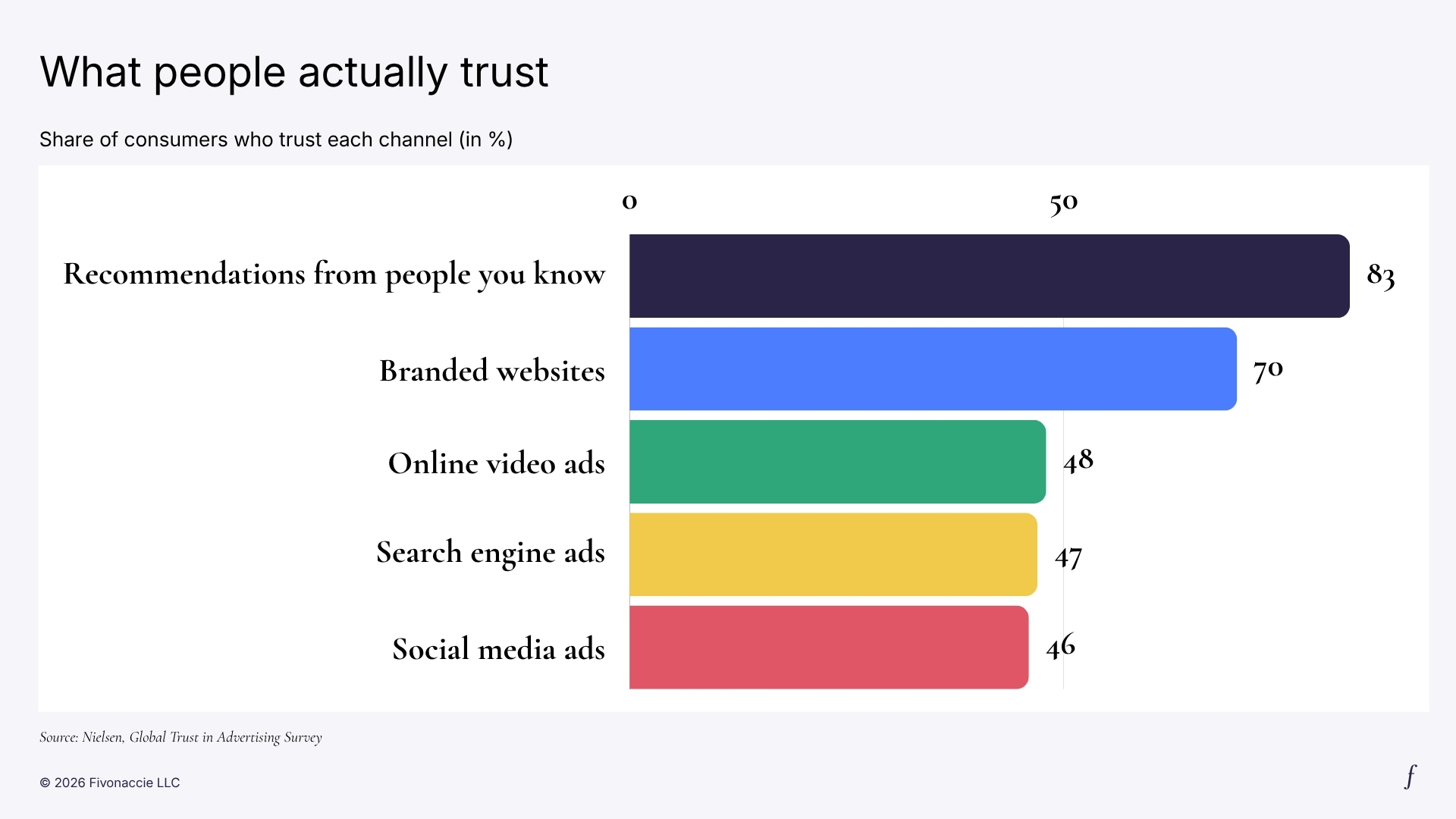
Recommendations from people you know are trusted at 83%, while paid social ads sit at 46%. Source: Nielsen, Global Trust in Advertising Survey.
Nobody can build the wave
Even if you wanted to chase it, the wave is not buildable. In 2006, three researchers ran an experiment that still ends most arguments about this. Matthew Salganik, Peter Dodds, and Duncan Watts built an artificial music market and let 14,341 people download songs by unknown bands. Some could see what others had downloaded. Some could not. When people could see the crowd, the same song became a hit in one version of the world and a flop in another, decided mostly by which tracks happened to get an early push. Quality set the floor and the ceiling. The best songs rarely bombed and the worst rarely won. Everything in between came down to luck, and social influence made success not more predictable but less.
That is the part the viral-formula sellers leave out. Every case study is written backward, after the wave already broke, by someone standing on the beach who happened to be holding a surfboard.
What the numbers do not say
Say it works anyway. Say the thing spreads. Now you are looking at a number that feels like proof. Two million views. Forty thousand likes. It looks like the business grew. It usually did not.
A 2023 meta-analysis in the Journal of Marketing pooled the research on brand social media and found the effect on engagement is stronger than the effect on sales. Content is good at producing likes. It is much worse at producing customers. The same analysis found the sales effect is stronger in small communities than large ones. A like is not loyalty, and a view is not trust. Trust is what we are actually selling, and it does not come from reach.
Go small on purpose
There is a better wave, and it is a small one. Creators with niche audiences beat the massive accounts on the numbers that move a business. On Instagram, small and focused accounts average around 3.86% engagement, while accounts over a million sit near 1.21%. More than triple. And those smaller creators convert roughly 20% better, because their audience already trusts them and already cares about the thing.
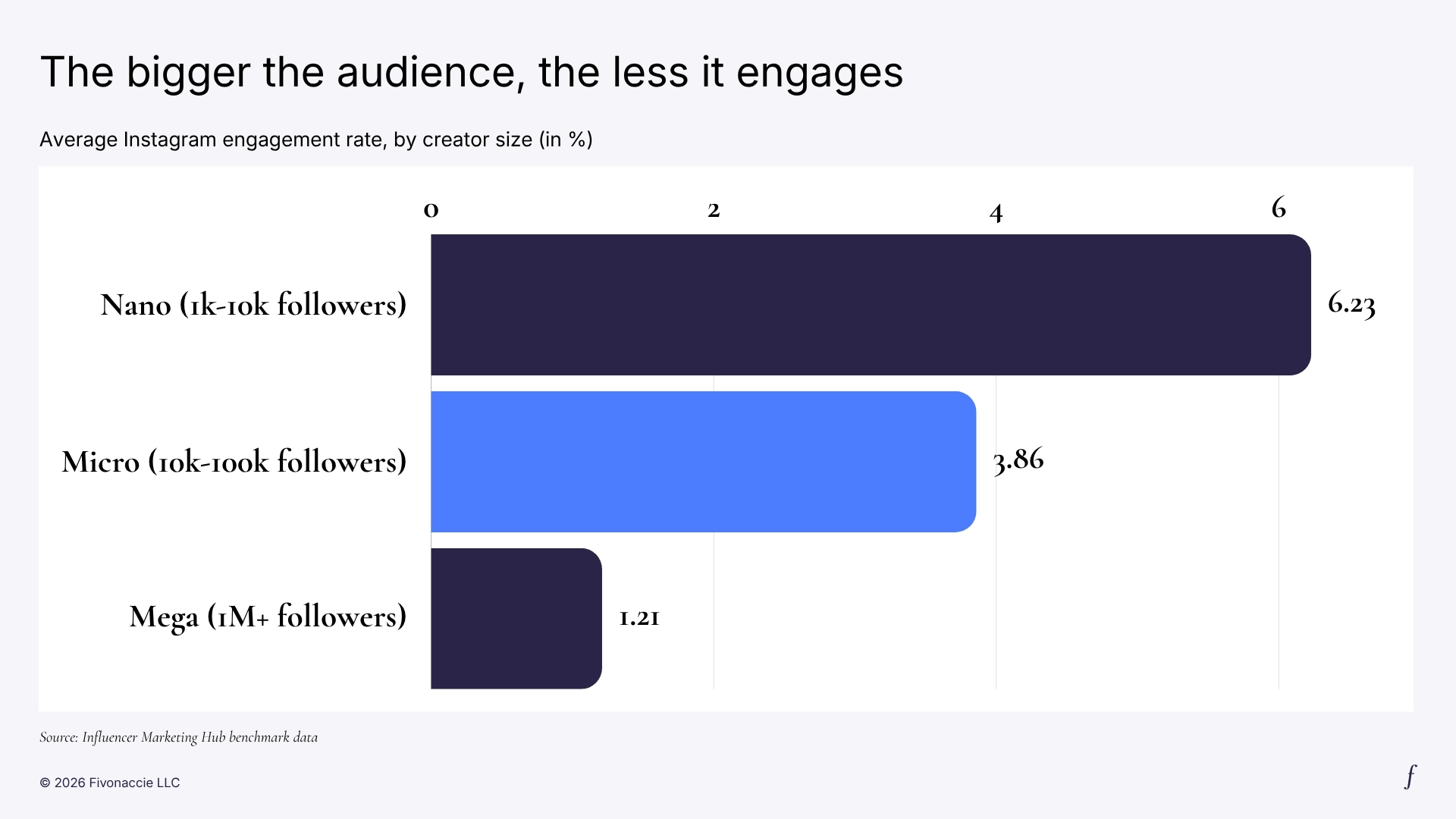
Engagement rate falls as the audience grows. Source: Influencer Marketing Hub benchmark data.
That is the version of going viral that helps you. Not a message that reaches everyone and means nothing. A message that reaches the right few thousand and means everything. When one of them tells a friend, that recommendation carries the trust no ad can buy.
None of this means hide. It means aim. Pick the person you are for and talk to them like they are the only one in the room. If the thing you make is good, they will carry it further than any algorithm would have, and it will still mean what you meant by the time it arrives.