
Every marketer's computer is a landfill of creative files. Versions of versions. The logo saved as logo_final, then logo_final_v2, then logo_really_final. Forty cropped profile pictures. Drafts of a post you published weeks ago. Screenshots you will never open again. It is what it is, and honestly we have all made our peace with it, because underneath the chaos we know exactly which file is which anyway.
There is a new file type in the pile now. At first it looks like one more thing to lose track of. It is not. It is the one file worth being deliberate about, because it does two things the rest cannot. It belongs to you and opens anywhere, and it is the format AI reads best. It is called markdown, and it has quietly become the most useful file a marketing team can keep.
So what is it? A markdown file is just plain text with a few small symbols. A hash makes a heading. Two asterisks make something bold. A dash starts a list. That is most of the entire language. You can read it with your own eyes, no app required, and open it in anything from a basic text editor to your website. John Gruber invented it back in 2004 because he was tired of typing HTML for his blog.
It reads everywhere, and it will outlive your tools
Because a markdown file is plain text, it opens in anything and belongs to no one. Every app can read it, from the notes app on your phone to a website builder. This is the part proprietary files get wrong. A Word document from 2004 can be a chore to open now. A markdown file from 2004 reads perfectly today, and will read perfectly in twenty years, because it is just text. When you want it as something else, a tool like Pandoc turns one markdown file into a web page, a PDF, or a slide deck on command. You write it once, and it becomes whatever you need.
It turns your pile of files into a single source of truth
Keep the content that matters in markdown and you get one clean original that everything else comes from. The blog post, the newsletter, the deck, the version you hand an AI to repurpose, all of it can start from the same portable file instead of being re-typed and re-styled for every tool. This is the quiet version of a content system. Not another platform to buy and migrate off of in two years. One file type to standardize on.
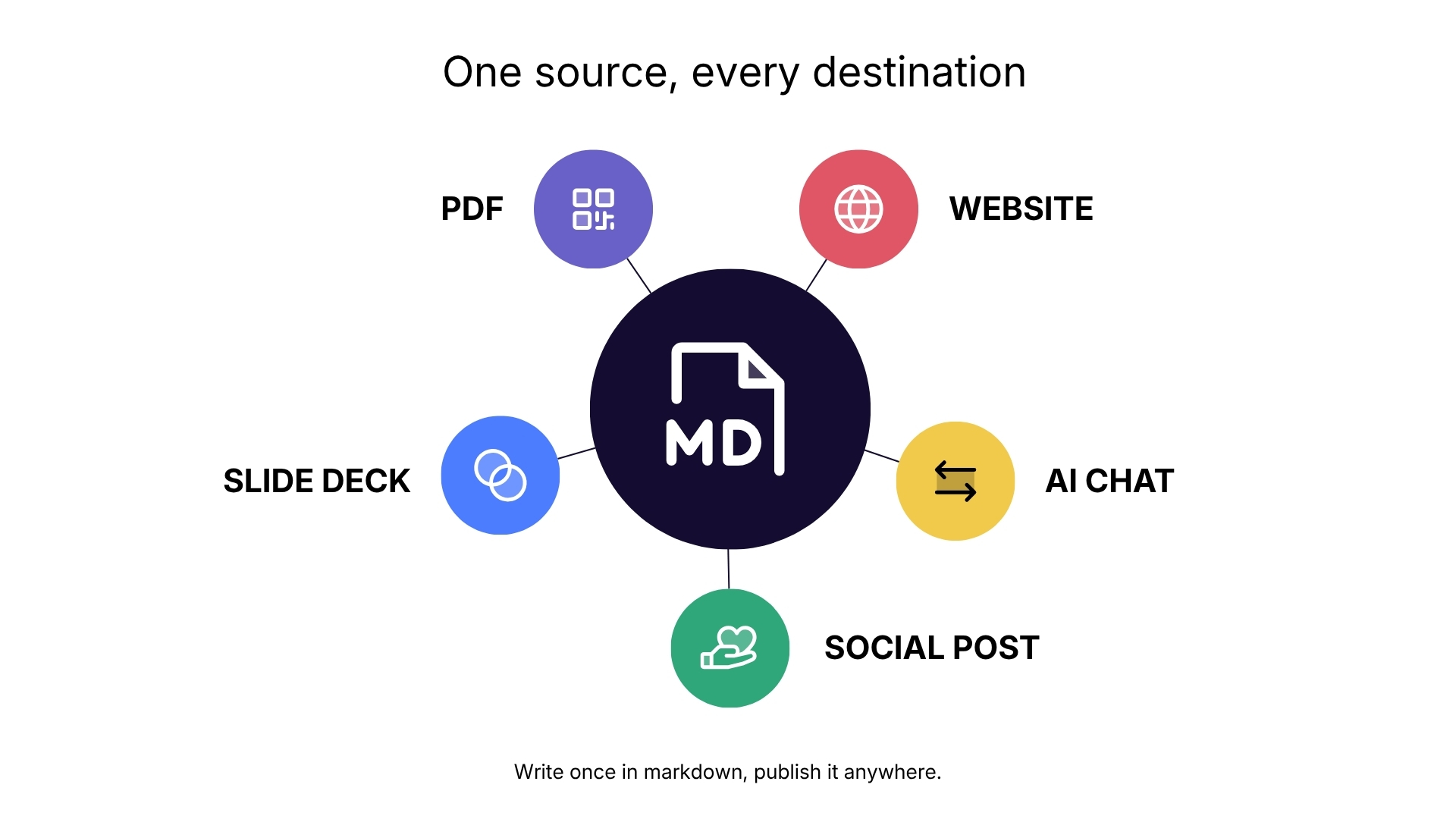 One markdown file can feed every channel you publish to, instead of living trapped in a single tool.
It is the format AI actually prefers
Everything you hand an AI tool becomes tokens, and tokens are both what you pay for and what fills up the model's limited attention. Plain text is the cheapest thing you can send, which makes markdown the leanest way to feed a model your content. The models were also trained on mountains of it, from code repositories to documentation, so they read its structure natively.
Compare that to the two things marketers usually paste into a chat. A screenshot of text is the most expensive, because the model burns a big fixed chunk of tokens just looking at the image and then has to guess the words from the pixels, which is slower and easier to get wrong. A PDF is lighter than an image but still heavy, since it drags along layout and page structure the model has to sort through. Markdown is only the words and their shape, so the same information arrives at a fraction of the weight.
Even against clean HTML, markdown wins. In the small example below it trims about 30% of the characters for identical content, and on a full, deeply nested page the gap grows much larger. By one estimate, a page can take around 65% fewer tokens as markdown than as HTML. Fewer characters mean fewer tokens, which means lower cost and cleaner answers.
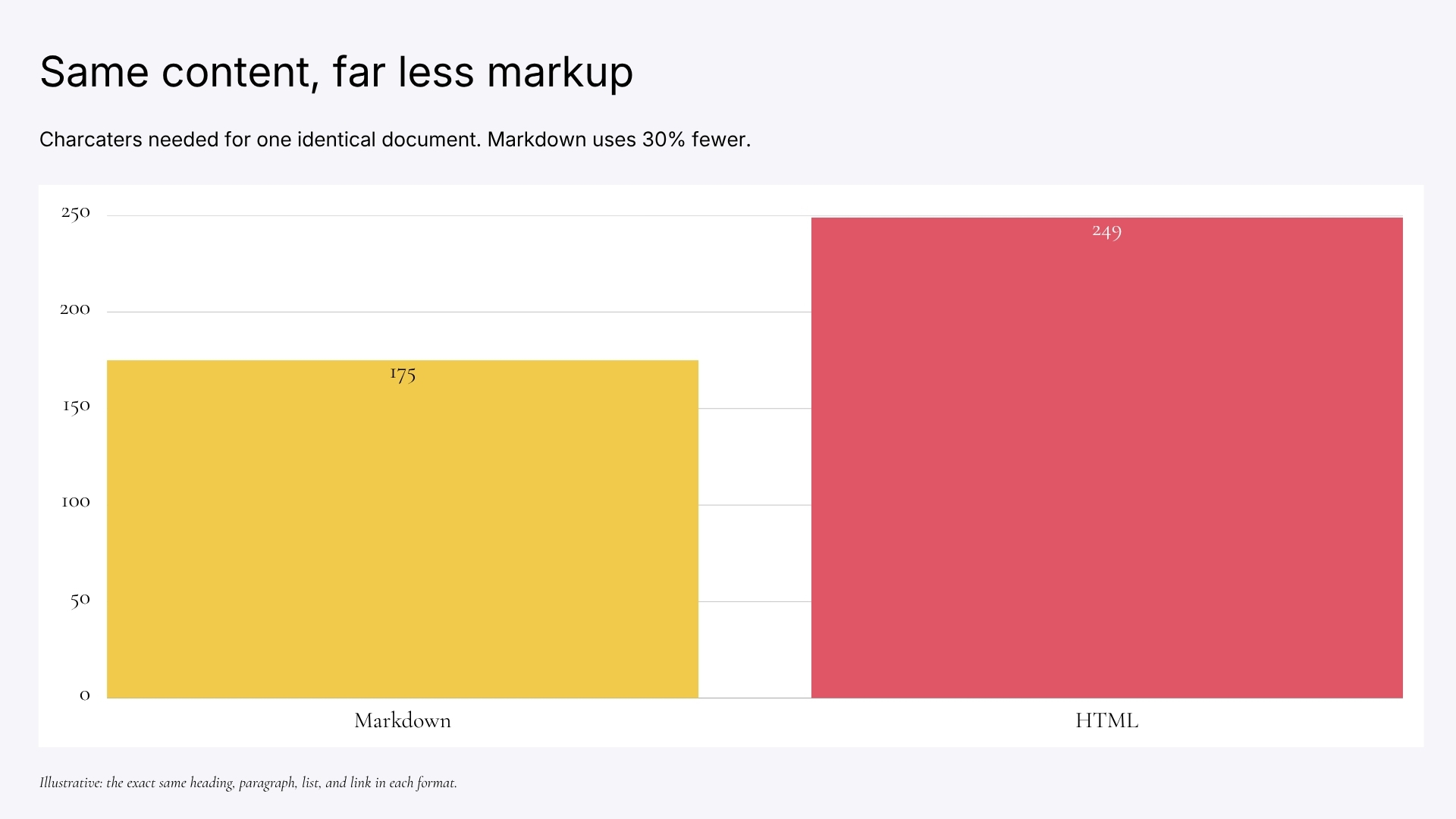
The same heading, paragraph, list, and link, written in each format. Markdown carries far less overhead, and the gap grows on larger documents.
Pro tip: turn the files you already have into markdown
The easiest way to start is to convert what you already use. Google Docs now exports markdown natively: open the document and choose File, then Download, then Markdown, and you have a clean, portable copy in one click. No add-on, no developer.
Here is how we use this at Fivonaccie. After a client meeting, we take the transcript, save it as a markdown file, and drop it into a shared Claude Project that holds every meeting transcript we have. Because markdown is so light, we can keep a huge history in one place without overwhelming the tool, then ask it something like what a client requested three months ago and get a straight answer with the receipts. The meetings turn into a searchable memory instead of a folder of recordings nobody reopens.
The reason all of this suddenly matters
Markdown went from a writer's shortcut to a piece of internet plumbing, and AI is why. There is even an emerging convention called llms.txt, a markdown file that websites publish specifically so AI can read them cleanly. The format one blogger made in 2004 to avoid typing HTML is now how the most advanced software on earth prefers to be spoken to. For anyone whose job is words and where they go, that is a quiet but real shift.
None of this asks you to become technical, or to finally clean up your desktop. Open any text editor, type a few lines, put a hash in front of the title, and save it as notes.md. That is a markdown file. It will still get lost among the other thousand files. It will just be the one that was worth keeping.