
Optimizing for the quarter is the most expensive habit in business, because the bill arrives late. When every dollar has to prove itself in ninety days, you spend it all on the people already reaching for their wallet and none of it on the ones who will need you next year. It works, right up until it does not. The numbers hold for a while, then acquisition gets more expensive and margins thin, and no one can name the quarter it started.
Here is the uncomfortable part. It started the quarter you stopped building the brand.
Two kinds of marketing, two different clocks
Brand building and sales activation are not the same job, and they do not pay out on the same schedule. Activation is the harvest: it captures demand that already exists, fast, and the effect fades just as fast. Brand building is the planting, slow and unglamorous, and it decides how big next year's harvest can be. Les Binet and Peter Field spent years in the IPA data and found the split that works. Across roughly 996 case studies covering 700 brands, the ones that grew most put about 60% of their budget into long-term brand building and 40% into short-term activation. Tilt too far toward activation and you get a sugar high, then diminishing returns, as price sensitivity climbs and the brand thins out.
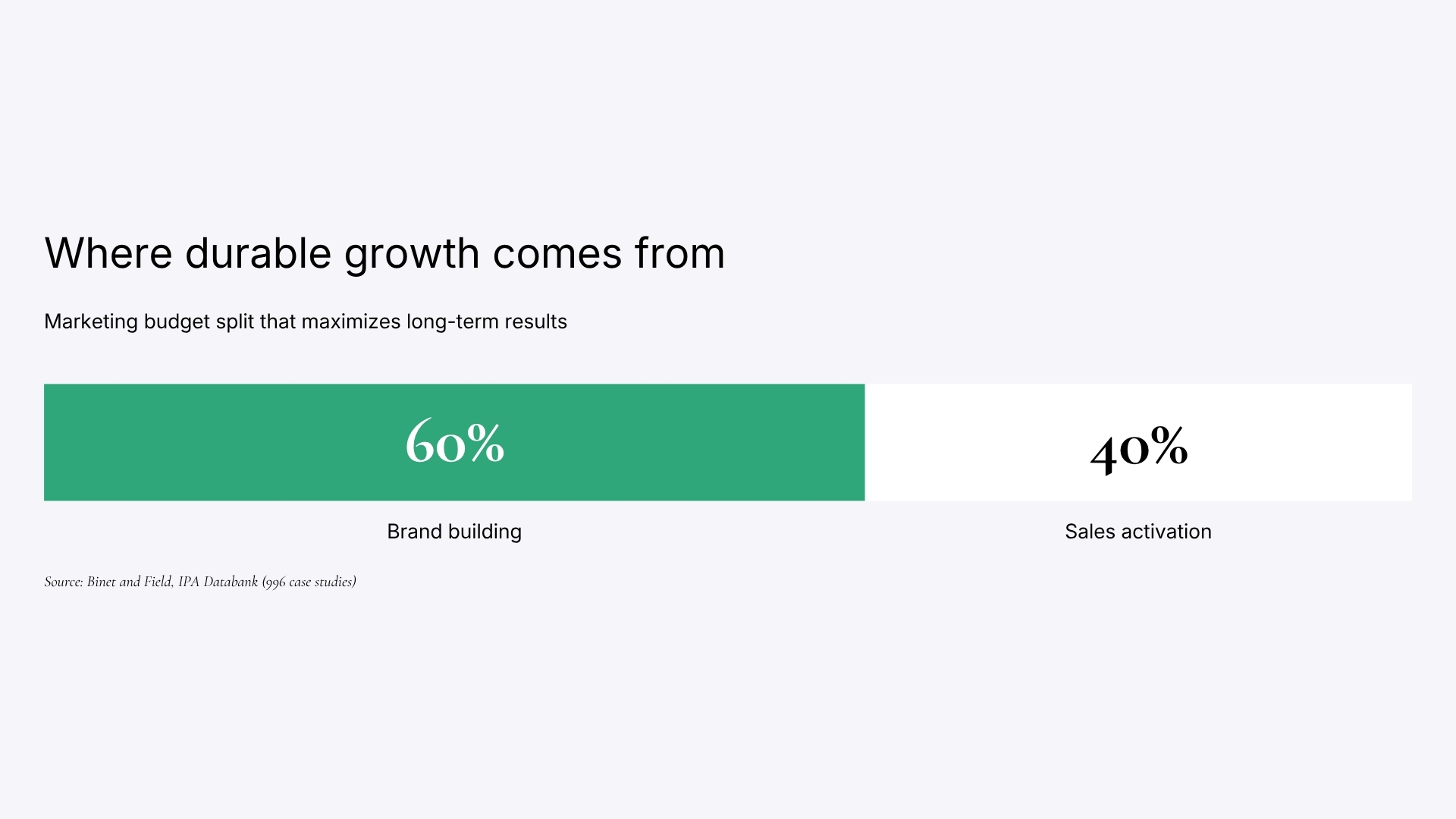
The allocation that maximizes long-term growth, from Binet and Field's analysis of the IPA Databank.
The ratio is not sacred. It shifts by category, and Binet and Field's later B2B work landed closer to even. But the direction is the point. Most companies pour money into the harvest and forget to plant.
Most of your buyers are not shopping today
The reason activation cannot carry a brand by itself is simple: on any given day, almost nobody is buying. Professor John Dawes at the Ehrenberg-Bass Institute put a number on it. In most categories, only about 5% of buyers are in the market right now. The other 95% are not, and no amount of "buy now" will move them, because they already have what you sell or are not ready to switch.
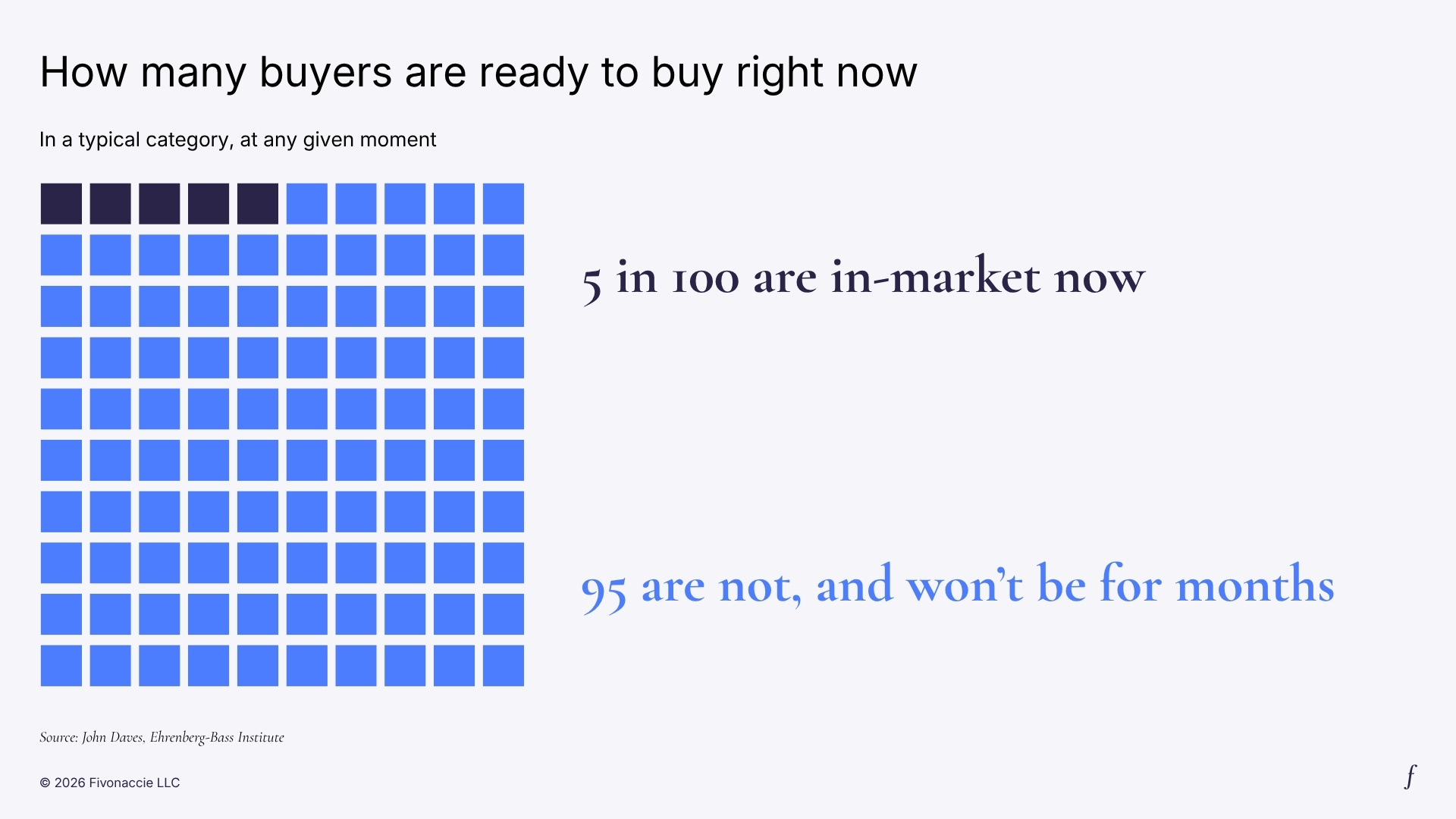
Only about 5 in 100 buyers are ready to buy at any given moment. The rest decide later. Source: the 95:5 rule, John Dawes, Ehrenberg-Bass Institute.
So a quarter spent shouting "buy now" reaches, at best, that 5%, the same slice every competitor is also fighting over, which is exactly why acquisition keeps getting more expensive. The other 95% see your ad and feel nothing, because you asked them for a decision they are not ready to make. Brand building talks to that 95% differently. It is not asking for the sale. It is making sure that when they do become the 5%, months or years from now, your name is the one already in their head.
Brand is an asset, not an expense
The mistake underneath all of this is a bookkeeping one. We file brand building under cost, something to trim when the quarter looks tight, when it is really an asset that appreciates. Every time your name lands with someone who is not ready to buy, you make a small deposit in a memory you will withdraw later. Stop making deposits and the account does not empty overnight. It empties slowly, which is why the damage is so easy to miss and so hard to reverse.
How to stop the quarter from winning
You do not fix this by swearing off performance marketing. You fix it by protecting a share of budget and attention for the slow work, and refusing to raid it every time a quarter gets nervous. Pick a split you can defend, closer to 60/40 than to all-activation. Measure brand building on its own clock: in familiarity and preference, not in this week's conversions. And treat the 95% as the real audience, the one you are quietly winning while everyone else fights over the 5%.
The quarter will always feel like the emergency. It rarely is. The real emergency is the year you spent so focused on harvesting that you forgot to plant, and walked into the next season with nothing coming up.